

Drone Types
Multirotor drones: quadcopters, hexacopters, octocopters


Multirotor drones earned their dominance by doing one thing extremely well: precise, stable flight at low speed with a payload that looks straight down or straight ahead. Instead of moving control surfaces, they change motor speed to tilt, turn, and hold position. This simplicity makes them fast to deploy, easy to integrate with sensors, and reliable when the job is close to the ground, near structures, or in tight airspace.
Types of Multirotor Drones
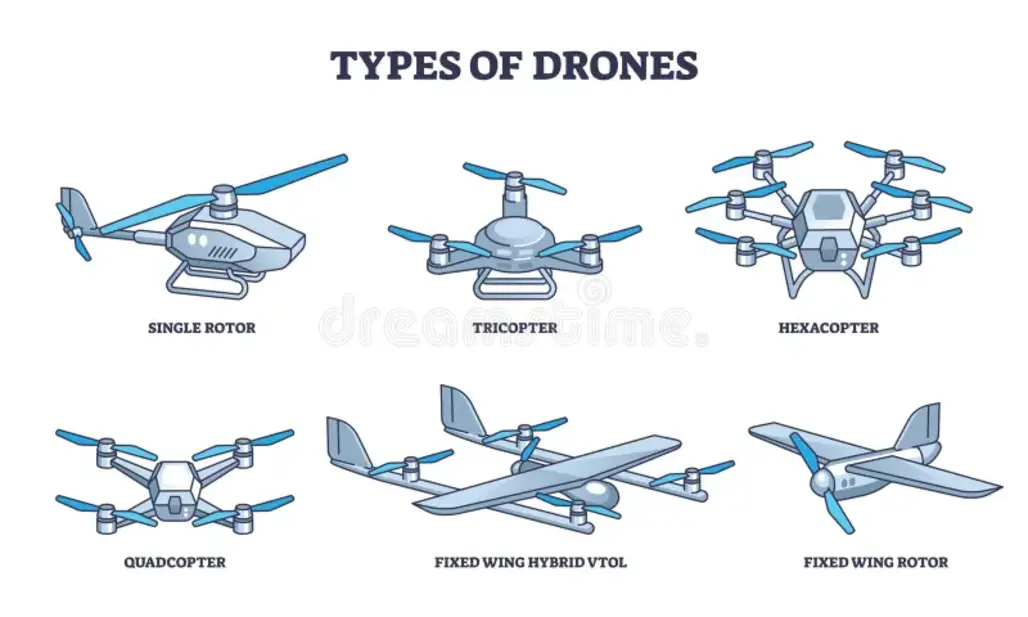
tricopter (3 rotors)
pros: very agile yaw authority; fewer parts and lower mass than quads; fun testbed platforms.
cons: mechanical tail-servo complexity; less common parts/support; limited payload and redundancy.
quadcopter (4 rotors)
pros: simplest architecture; lightest and cheapest for a given payload; compact footprint; fast to field and maintain.
cons: no true motor-out survivability in standard mixers; lower total thrust and wind margin than larger counts.
x8 coaxial quad (8 rotors, 4 arms)
pros: high thrust density in a compact span; some motor-out tolerance; fits tight takeoff/landing zones.
cons: efficiency hit from coax interference (often 5–15%); reduced yaw authority; more heat near stacked motors/escs.
hexacopter (6 rotors)
pros: more thrust and better wind handling than quads; partial motor-out landability with proper tuning; good sensor payload class.
cons: higher cost, wiring complexity, and EMI management; larger pack currents if staying on low voltage.
x12 coaxial hex (12 rotors, 6 arms)
pros: heavy-lift in a manageable diameter; strong redundancy for valuable payloads; smooth control for gimbals.
cons: efficiency and yaw penalties vs flat hex; weight and cost rise quickly; thermal management is critical.
octocopter (8 rotors)
pros: maximum thrust and control authority in flat layouts; excellent stability for cinema, LiDAR+IMU, precision lift.
cons: largest airframe and drag for a given prop size; higher parts count and maintenance; transport logistics.
x16 coaxial octo (16 rotors, 8 arms; niche heavy-lift)
pros: extreme thrust density and redundancy; supports very heavy or mission-critical payloads.
cons: significant efficiency losses, complexity, and cost; careful structural and thermal design required.
How multirotor Drones Actually Fly
A multirotor lifts on the combined disks of its propellers. Control is nothing more than tiny differences in thrust. To roll, the flight controller speeds up motors on one side and slows the opposite side. To pitch, it does the same fore and aft. Yaw is created by exploiting rotor torque; motors that spin one way are sped up while counter-rotating partners are slowed, turning the airframe without changing altitude. Because there are no swashplates or variable-pitch mechanisms, response is quick and predictable—ideal for hovering over a roof seam, a powerline insulator, or a crowd perimeter.
Two ideas matter for performance. First, thrust-to-weight ratio: practical work platforms sit around 1.8–2.5 at takeoff, giving enough headroom to climb, fight gusts, and carry a reserve. Second, disk loading: the total weight divided by the total area of all prop disks. Lower disk loading means better hover efficiency and gentler behavior in turbulent air. That’s why larger, slower props often feel calmer and fly longer.
What’s Inside Modern Multirotor Drones
The airframe is usually a rigid carbon structure with arms long enough to mount the chosen propellers while keeping tips away from the fuselage and the camera’s field of view. Longer arms allow larger, slower props and lower disk loading, but they also add drag and bending loads. The propulsion chain runs from the battery through a power distribution board to ESCs and then to brushless motors and fixed-pitch props. High refresh ESC protocols and field-oriented control help motors track flight-controller commands cleanly, which you can hear as a smooth, low-noise note in flight.
Avionics center on a flight controller with dual IMUs, a barometer, and a magnetometer, fused with GNSS or RTK for absolute positioning. Rangefinders or LiDAR add precise altitude and terrain hold. Companion computers run SLAM or on-board AI for obstacle avoidance and targeted inspection, while radios handle command and telemetry—short-range RC for line-of-sight work, or LTE/5G and mesh radios when operations push toward BVLOS. Power choices matter: LiPo packs deliver higher burst current and good cold-weather behavior; Li-ion packs trade peak current for longer endurance. Larger craft often move to higher bus voltages to cut current and heat.
Quad vs Hex vs Octo: Choosing the Right Count
Quads are the simplest. With four motors they minimize parts, mass, and cost. This makes them the default for mapping cameras, thermography, and light LiDAR. The trade-off is that a single motor failure often can’t be saved, so quads lean on prevention, health monitoring, and conservative envelopes.
Hexacopters add two more thrust points. They carry more, handle wind better, and with the right mixer can tolerate a motor failure long enough to land. That margin is valuable when flying heavier sensors, working around towers, or dealing with coastal gusts.
Octocopters sit at the top end. They provide the smoothest control authority and the most redundancy, especially in coaxial layouts where a second motor sits above or below the first on each arm. Coaxial stacks increase thrust density and keep the span reasonable, at the cost of aerodynamic interference that trims efficiency. If you’re flying a cinema rig, a heavy LiDAR with a precision IMU, or lifting a tool where stability matters more than raw endurance, an octo is usually the right answer.
Why Geometry and Props Change Everything
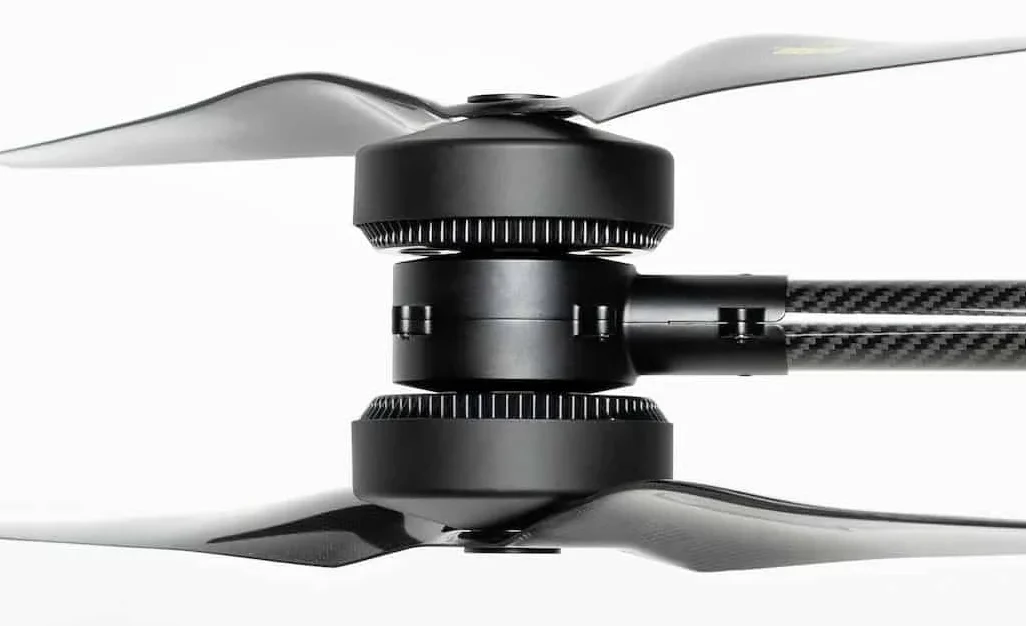
The frame geometry is not only about looks. Arm length sets allowable prop diameter, and prop diameter sets both efficiency and sound. Bigger, slower props usually mean longer flight time and a less irritating acoustic signature, which can be a factor for urban or wildlife jobs. Prop pitch needs to match the mission profile: shallow pitch improves hover efficiency and braking; higher pitch helps in faster cruise.
Yaw authority deserves attention. Multirotors yaw by creating torque differences, and coaxial stacks reduce the available yaw moment because counter-rotating blades cancel each other’s torque. That’s fine for most mapping or cinema profiles but calls for careful tuning if the aircraft must track a fast-moving subject or fight strong crosswinds during a hover-turn.
Energy Systems and Thermal Margins
Endurance is a simple ratio—usable watt-hours divided by average power at the mission profile—but the devil is in current and heat. Higher voltage means lower current for the same power, which reduces losses in wires and ESCs. Size ESCs, connectors, and traces for continuous current with a healthy margin, not just peak. Keep ESCs in clean cooling flow. Watch battery internal resistance trends over the pack’s life; rising IR shortens flights and increases voltage sag, which can trip low-voltage failsafes when you punch out of a thermal or climb to clear an obstacle.
Hybrids and fuel cells extend endurance for overwatch and long surveys. They introduce vibration and heat management issues and require a small buffer battery for transients. They shine when the payload draws little power but the mission requires hours of station keeping.
Reliability and Safety, Engineered into Multirotor Drones
Redundancy grows with rotor count, but it also comes from architecture. Dual IMUs and GNSS with voting logic guard against single-sensor bias. Separate power rails for avionics and payloads prevent camera surges from browning out the flight controller. Configure clear behaviors for link loss, geofence breaches, and low voltage: return-to-home isn’t always best near obstacles; sometimes a controlled descent to a safe zone beats climbing into an overpass. For heavier classes, parachutes can reduce risk, but only if they’re sized and tested for the actual speed and altitude envelope you fly.
Where Each Multirotor Drone Configuration Excels
Quads dominate rapid-deploy missions: RTK photogrammetry, roof thermography, light LiDAR, and indoor scans with caged frames. Hexes take over when wind, payload mass, or safety margins rise—utility corridor LiDAR, telecom inspection with heavier optics, or coastal SAR with a small drop kit. Octos carry the heaviest and most demanding payloads. They give gimbal operators smooth authority for cinema and protect expensive sensors with motor-out survivability and low-vibration platforms for inertial measurement units.
What’s Next for Multirotor Drones?

Three trends are reshaping the category. First, higher voltage and better motor control are making large aircraft quieter and more efficient. Second, fuel cells are creeping into fielded systems, enabling silent, long-endurance overwatch with minimal thermal signature. Third, autonomy is moving from “hold position and avoid a wall” to “finish the job despite GNSS dropouts and moving obstacles,” powered by better perception and on-board inference. Around them, infrastructure is maturing: roof nests and box launchers that recharge and protect drones so fleets can respond automatically.
Conclusion
Choose the rotor count for the mission, not the brand chart. Quads win on simplicity and cost for light sensors and short jobs. Hexes add thrust and a safety cushion for real-world wind and payloads. Octos deliver stability and redundancy for the heaviest and most valuable payloads. Size props for low disk loading, keep thermal margins real, and instrument the aircraft so you can prove it is healthy. Do those things well and multirotor drones become not just a flying camera, but a dependable tool your team will trust near people, infrastructure, and the places where precision matters.
Frequently asked questions about multirotor drones
What’s the practical difference between a quadcopter, hexacopter, and octocopter?
Quads minimize parts and cost for light payloads. Hexes add thrust and limited motor-out survivability. Octos maximize control authority and redundancy for heavy or high-value payloads, often using coaxial arms to keep span manageable.
How do multirotors steer without control surfaces?
They vary motor RPM. Opposing arms speed up or slow down to create roll and pitch; yaw comes from torque imbalance between counter-rotating rotors. No swashplates or variable pitch are required.
What thrust-to-weight ratio should I target?
Work platforms typically fly best between 1.8 and 2.5 at takeoff. Lower feels sluggish and wind-limited; higher improves gust margin, climb, and tracking but may trade some endurance if props are undersized.
What is disk loading and why does it matter?
Disk loading is total weight divided by the combined area of all propeller disks. Lower disk loading improves hover efficiency, stability in turbulence, and acoustic comfort. Larger, slower props reduce disk loading.
When does a hex or octo actually survive a motor failure?
Only if the mixer and control tuning support it and there is sufficient thrust margin. Flat hex and octo layouts with adequate RPM headroom can hold attitude and descend under control; quads generally cannot.



