Flight Decisions
Controlled Airspace Mistakes Drone Pilots Make


eControlled airspace is one of the most misunderstood concepts in drone aviation, and it’s where many pilots make critical controlled airspace mistakes without realizing it. Not because the rules are overly complex, but because they are consistently oversimplified.
Pilots tend to reduce airspace into easy assumptions. Near an airport, they think it’s off-limits. Can’t see anything nearby, they assume they’re safe. Drone is small, they believe the rules don’t fully apply.
Those shortcuts might feel logical in the moment, but they’re exactly what lead to violations, failed exams, and unsafe operations. Controlled airspace isn’t built around guesswork, it’s built around coordination. And if you don’t understand that system, you’re not making a real flight decision.
Why Controlled Airspace Causes So Much Confusion
Part of the problem is that controlled airspace doesn’t behave like something you can see or feel. There are no physical boundaries marking where it begins. You can stand in what appears to be a completely open environment and still be operating within restricted airspace tied to an airport miles away.
On top of that, the system itself isn’t simple. Airspace is layered, with different classifications and rules that can change depending on altitude, location, and country. What applies in one jurisdiction may not apply in another, and even within the same area, the rules can shift vertically as you climb.
For most pilots, that creates a gap between what feels intuitive and what is actually correct. And when intuition replaces verification, controlled airspace mistakes become inevitable.
What These Mistakes Look Like in Real Flights
These mistakes rarely come from deliberate risk-taking. More often, they show up in completely ordinary flights.
A pilot launches from a quiet suburban park, confident the area is safe, without realizing they are inside controlled airspace associated with a nearby airport. Another checks an airspace app briefly, misinterprets the boundary, and assumes they’re outside controlled airspace when they’re not. Someone else assumes their lightweight drone gives them more freedom than it actually does.
In each case, the pilot is acting on incomplete understanding. Nothing about the environment feels dangerous, which makes the mistake harder to recognize in the moment.
That’s what makes controlled airspace so different from other risks. It doesn’t always look like a problem until it already is one.
The Most Common Controlled Airspace Mistakes

Controlled Airspace Means “No-Fly Zone”
One of the most common controlled airspace mistakes is treating it as completely off-limits.
In reality, controlled airspace is often accessible, but only under the right conditions. In many regulatory systems, including those in the United States and the UK, pilots can operate in controlled airspace with proper authorization.
The distinction matters. Controlled does not mean prohibited. It means managed.
Once you understand that, the question shifts from “Can I fly here?” to “What do I need in order to fly here legally?”
Small Drones Don’t Count
Another misconception that continues to surface is the belief that smaller drones operate outside of standard airspace rules.
While lighter drones may fall into categories that allow more flexibility in certain situations, they are not exempt from airspace restrictions. Controlled airspace applies regardless of size.
This misunderstanding often comes from how consumer drones are marketed. Smaller drones feel more accessible, more casual. But the airspace they operate in does not change just because the aircraft is smaller.
Authorization Is Optional
There is also a tendency to treat authorization as a technicality rather than a requirement.
In reality, authorization systems are central to how controlled airspace functions. In the United States, systems like LAANC allow pilots to request near-instant approval in certain areas. UK and other countries, operations near aerodromes or within designated zones require coordination or permission.
These systems are not barriers, they are the mechanism that makes safe integration possible. Ignoring them isn’t just a shortcut; it undermines the structure that keeps the airspace predictable.
Airspace Is Flat
Another subtle but important mistake is thinking of airspace as a flat boundary on a map.
Airspace is three-dimensional. In some locations, controlled airspace begins at ground level. In others, it starts higher up. That means a flight that appears compliant at takeoff can enter controlled airspace as the drone climbs.
Without understanding how altitude affects airspace, it’s easy to misjudge whether a flight is actually legal.
If You Can’t See the Airport, You’re Safe
This is one of the most intuitive, and most misleading, assumptions.
Airspace is not based on visibility. Airports don’t define their influence by what you can see from the ground. Controlled airspace often extends well beyond the physical airport itself.
Relying on visual cues instead of verified airspace data is one of the most consistent sources of controlled airspace mistakes.
What Pilots Get Wrong About Controlled Airspace
When you step back, the pattern becomes clear.
These mistakes aren’t about a lack of effort. They come from trying to simplify something that isn’t meant to be simplified.
Pilots often replace structured thinking with mental shortcuts. They rely on distance, visibility, or drone size instead of working through the actual decision process.
But controlled airspace doesn’t respond to intuition. It responds to verification.
Understanding that shift, from assumption to structure, is what separates a confident pilot from a compliant one.
How to Actually Know If You Can Fly
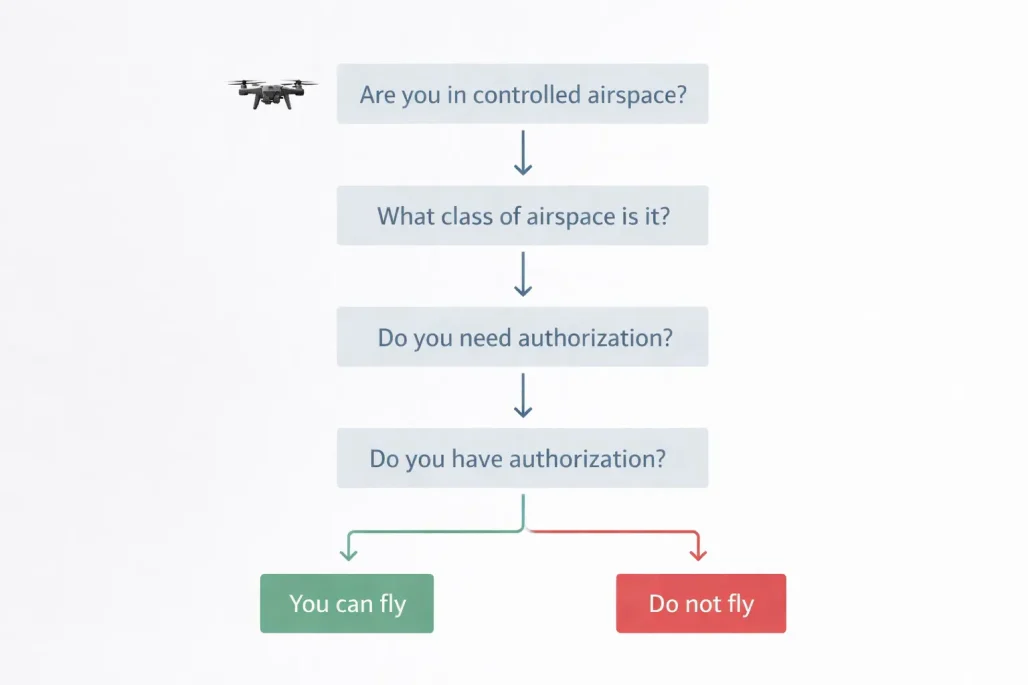
The most effective way to avoid controlled airspace mistakes is to follow a consistent decision process before every flight.
Start by confirming whether you are in controlled airspace using a reliable map or tool. From there, identify the class of airspace and determine whether authorization is required.
If authorization is needed, the next step is straightforward: do you have it?
If the answer is no, then the decision is already made. The flight does not proceed.
This approach removes uncertainty. Instead of guessing, you are working through a system that reflects how the airspace is actually designed.
Controlled vs Uncontrolled Airspace
At a high level, the distinction between controlled and uncontrolled airspace is simple, but it only works if you apply it correctly.
| Airspace Type | Can You Fly? | Authorization Required |
|---|---|---|
| Controlled | Sometimes | Yes |
| Uncontrolled | Yes | No |
The challenge isn’t understanding this table. It’s accurately determining which side of it your flight falls on.
Why the Rules Exist
It’s easy to see airspace rules as restrictions, but they are better understood as a coordination system.
Manned aircraft rely on controlled airspace to operate safely and predictably. Introducing drones into that environment without coordination creates uncertainty, not just for pilots, but for everyone sharing that airspace.
These rules exist to maintain separation, ensure predictability, and allow different types of aircraft to operate safely together.
As drone usage continues to grow, that coordination becomes more important, not less.
How This Appears on Drone Exams
Controlled airspace is one of the most challenging areas for pilots during certification exams.
It’s not because the questions are trick questions. It’s because they test understanding, not memorization.
Pilots are asked to interpret charts, identify airspace classes, and determine whether authorization is required. Without a clear mental model of how airspace works, those questions become difficult quickly.
That’s why the same controlled airspace mistakes that happen in real flights often show up in exam results as well.
Practical Tips to Avoid Airspace Mistakes
The difference between guessing and knowing comes down to habits.
Pilots who consistently check airspace using verified tools, understand their local regulations, and confirm authorization requirements before flying are far less likely to make mistakes.
Just as importantly, they avoid relying on what feels right in the moment. They rely on what has been verified.
That shift, from instinct to process, is what keeps flights compliant.
Conclusion
Controlled airspace is not inherently off-limits, but it is structured in a way that requires deliberate decision-making.
Most controlled airspace mistakes don’t come from reckless intent. They come from simplifying a system that requires careful interpretation.
Pilots who take the time to understand how airspace actually works don’t just avoid violations, they operate with confidence and clarity.
If there’s one takeaway, it’s this:
👉 Safe flying doesn’t come from assumptions. It comes from understanding the system you’re operating in.
Make the Right Call Before You Fly
This scenario is just one piece of the bigger picture. Your flight may still be affected by airspace, weather, and other restrictions.
Use FlyEye to Double-Check Your Operation
Strengthen Your Understanding
Pilots often get these related topics wrong:
Frequently Asked Questions
Can drones fly in controlled airspace?
Yes, but typically only with authorization depending on the country and airspace class.
Do I always need authorization?
In controlled airspace, authorization is usually required before flying.
What is controlled vs uncontrolled airspace?
Controlled airspace requires coordination or authorization, while uncontrolled airspace generally allows flight without prior approval.
Why is controlled airspace restricted?
To maintain safe separation between drones and manned aircraft and ensure predictable airspace operations.