Flight Decisions
Can You Fly at Night Under Part 107?


To fly at night under Part 107 it used to require a waiver. That changed.
Today, commercial drone pilots in the United States can legally fly at night under Part 107 — but only if specific conditions are met. The FAA removed the blanket night waiver requirement in 2021, replacing it with training and equipment standards.
So the answer is yes — but not automatically.
Fly at Night Under Part 107 – What the Regulation Says
Night operations are governed by 14 CFR §107.29, enforced by the Federal Aviation Administration.
Under current FAA rules, a remote pilot may operate at night if:
- The pilot has completed updated recurrent training that includes night operations, and
- The aircraft is equipped with anti-collision lighting visible for at least 3 statute miles
You can verify this directly:
- 14 CFR §107.29 (Night Operations)
- FAA Operations Over People & Night Rule Summary
- FAA Recurrent Training Guidance
The rule no longer requires a waiver for standard night flight, provided these conditions are satisfied.
What Counts as “Night”?
Under FAA definitions, night begins at the end of evening civil twilight and ends at the beginning of morning civil twilight, as published in official almanacs.
This distinction matters because twilight and nighttime are treated differently in regulatory terms.
If your flight extends past civil twilight, night operation requirements apply.
The Anti-Collision Lighting Requirement to Fly at Night
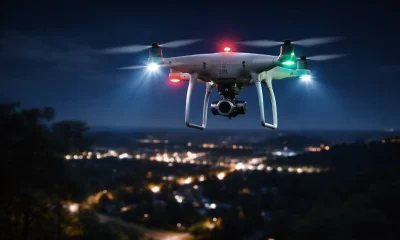
The aircraft must be equipped with anti-collision lighting visible for at least 3 statute miles.
The light must:
- Flash sufficiently to avoid collision risk
- Be visible to other airspace users
- Remain operational throughout the flight
Pilots may reduce brightness if necessary to prevent glare, but the visibility requirement remains.
Standard navigation LEDs are not always sufficient unless they meet the 3-mile visibility standard.
Training Requirements to Fly at Night
Pilots who received certification before the 2021 rule change must complete updated recurrent training that includes night operations.
New pilots take the updated knowledge test that incorporates night-flight material.
Flying at night without meeting training requirements places the operation out of compliance — even if the aircraft has proper lighting.
What Night Flying Does Not Override
Flying at night does not remove other operational restrictions.
You must still:
- Maintain visual line of sight
- Comply with airspace authorization requirements
- Follow operations-over-people rules
- Avoid hazardous operations
Darkness does not expand your privileges.
Enforcement Reality
The FAA treats night operations seriously because reduced visibility increases collision risk.
Operating without compliant lighting or proper training may result in civil penalties or certificate action.
If an incident occurs at night, scrutiny increases significantly.
Practical Compliance Standard
Professional operators treat night flights as higher-risk missions.
Before launching at night:
- Confirm recurrent training is current
- Verify anti-collision lighting visibility
- Reassess obstacle awareness
- Consider depth perception limitations
Night flying is legal — but only when properly prepared.
Frequently Asked Questions
Do I still need a waiver to fly at night?
No, not for standard operations that meet §107.29 requirements.
Do recreational pilots have different rules?
Yes, recreational pilots follow separate statutory requirements.
Can I dim the anti-collision lights?
Yes, if necessary to prevent glare — but visibility standards still apply.
Does night flying allow BVLOS?
No. Visual line of sight must still be maintained.
Helpful Tools
• Flight Check
• U.S. regulation guide
• FAA Part 107 practice exams
• Acronym directory
FlyEye Perspective
Night Flying Part 107 is no longer a waiver-only privilege. It is a regulated operational category with clear conditions.
If your training is current and your lighting meets FAA standards, night operations are legal.
Professional pilots treat darkness as a risk factor — not a loophole.